miércoles, 28 de julio de 2010

Alas muy Grandes: Vencejos

Hace un par de semanas fui de excursión al pueblo de Coca para visitar un castillo que era hace siglos una magnífica fortaleza en Castilla y León y que ahora se ha convertido en una escuela dentro de la vieja estructura desmorona. Cerca a los servicios, había un cilindro de piedra se abría al cielo (donde una vez una escalera espiral o una torreta había estado una vez) que media unos cuarenta metros de altura. Tirado en el piso de este lugar hubo un pájaro negro bocabajo.
Es extraño ver a un ave acostada del vientre. Muerto, por lo general se encuentra a un lado. Vivo, por lo general, se encuentra de pie o sentadita en sus nidos. Pero este pájaro estaba en el suelo bocabajo. Un pájaro negro el tamaño de mi mano con alas enormes.
El vigilante del lugar me dijo que este tipo de ave no puede pisar la tierra debido a sus alas enormes y piernas demasiado cortas. Como resultado, tienen que volar constantemente, cazando mosquitos en el aire para mantenerse vivos.
Vencejos Volando al acueducto romano de Segovia
Así que el hombre fue al baño y salió con un puñado de papel higiénico. Trató de recoger el pájaro, pero se aferró obstinadamente a la tierra con sus patas cortas, suponiendo (lógicamente) que el hombre tenía planes de cenar de pájaro. Deslicé los dedos debajo del pájaro y lo liberé de la tierra, después de que el ave clavó sus garras en el dedo. Llevamos el pájaro fuera y lo liberamos en el aire, donde el voló inmediatamente, subiendo encima del castillo para reunirse con sus compañeros.

Esta ave (que se llama vencejo) suele permanecer en el aire durante tres años sin tocar el suelo. Durante el día, pueden estar vistas volando rápidamente con movimientos circulares cazando insectos alrededor de las catedrales y arcos altos de las ciudades de España. Por la noche, suben a altitudes de 2.000 metros o más, y duermen en el cielo, sin parar de volar. Qué irónico que la naturaleza ha creado una criatura que vuela tan magníficamente que su capacidad de la tierra se deteriora.


Lectura recomendada: Un hombre viejo con alas enormes--por Gabriel Garcia Marquez


A couple of weeks ago I went on an excursion to a place called Coca to visit a castle that was once a magnificent fortress in Castilla y Leon and has now been converted into a school within the old crumbling structure. Over by the bathrooms there was a cylinder of stone opening out into the sky (where once a stairway or a turret had once been) about fourty meters high. Lying on the floor of this place was a black bird lying on its belly.

It’s strange to see a bird lie on its belly. Dead, it usually lies on its side. Alive, usually it stands on its feet or sits in its nest. But this bird lay on its belly. A black bird about the size of my hand with enormous wings.

The caretaker of the place told me that these kinds of birds can’t get back off of the ground once they land because their wings are too large and their legs too short. As a result, they have to fly constantly, catching mosquitos in the air in order to stay alive.

So the man goes into the bathroom and comes out with a fistful of toilet paper. He tries to pick the bird up, but it clings stubbornly to the earth with its short legs, assuming (logically) that the man has plans to make the bird his dinner. I slide my fingers under the bird and release it from the earth, whereupon it digs its little claws into my finger instead. We carry the bird outside and release it into the air where it takes flight immediately, climbing high above the castle to join his fellow birds.

As it turns out, this bird has been known to remain in the air for three years without touching the ground. By day, these birds can be seen flying swiftly in circular motions hunting insects around the cathedrals and high arches of the cities of Spain. At night, they climb to altituides of 2,000 meters or more and sleep up in the sky, still flying. How ironic that nature has created a creature that flies so magnificently that its ability to land becomes impaired.

martes, 27 de julio de 2010

Aquellas Pequeñas Cosas

Aquí les presento una canción del cantante Barcelonés Juan Manuel Serrat. Serrat fue uno de los fundadores de la Nova Cançó catalana, una generación de cantantes que promovían el uso del catalán durante los años de la Dictadura de Franco cuando el uso del lenguaje era prohibido. Sin embargo, esa canción está escrita en castellano y viene acompañado con una traducción mía muy ligera en ingles. Espero que la disfruten.
Escucha la cancion

"Aquellas Pequeñas Cosas"
(Música y letra de J.M. Serrat)

Uno se cree
que los mató
el tiempo y la ausencia.
Pero su tren
vendió boleto
de ida y vuelta.
Son aquellas pequeñas cosas
que nos dejó un tiempo de rosas
en un rincón,
en un papel
o en un cajón.
Como un ladrón
te acechan detrás de la puerta.
Te tienen tan
a su merced
como hojas muertas,
que el viento arrastra allá o aquí...
que te sonríen tristes y
nos hacen que
lloremos cuando
nadie nos ve.


Here I present to you a song from the excellent songwriter from Barcelona Juan Manuel Serrat. Serrat was one of the founders of the movement Nova Cançó catalana (The New Song in Catalan) during the Franco Dictatorship when the use of the language was prohibited. Nevertheless, this particular song is in Castillian Spanish and I have added a very loose translation of my own. I hope you enjoy it.

 "Little Things like this"

(Music and lyrics by J. M. Serrat)


Just when you think

that you have killed

the empty passage of time and longing.

You realize that this train

has already sold you a ticket--

and it’s round trip.

It’s the little things like that

that have made ours a time of roses

in a corner

or on a sheet of paper

or buried in a drawer.

Like a thief waiting

They crouch behind the door.

They have you so completely

at their mercy
that you are carried like dead leaves,

dragged here and there by the wind ...

These leaves that smile sadly at you

and they make us all
cry
when nobody’s looking.


lunes, 26 de julio de 2010

Grafitis


Noticia: Hombre no se cae del balcón Salamantino

Me encanta estar vivo. Cada momento que tenemos es precioso: este momento** este momento** este momento**. Cada momento es el material que compone nuestras vidas. De vez en cuando, la importancia y el valor de mi vida me da un golpe inesperado.

El otro día estaba en un balcón del piso octavo mirando a la cúpula iluminada de la Catedral de Salamanca y la Universidad Pontificia. Brillaban como islas sobre un mar de arcilla roja. Mirando hacia abajo, podia ver la calle Canalejas, una avenida ancha que rodea el casco antiguo de la ciudad, donde las murallas que protegían la ciudad se ubicaban en el pasado, mirando a la gente de paseo por las aceras crepusculares en parejas y grupos.

Cuando me incline sobre la baranda, me sentí una sensación que tengo a veces tengo cuando cruzo puentes y me paro en terrazas altas: una gravedad inmensa del deseo y miedo que me enhiela el cuerpo.
Obiamente, no quiero caerme, pero sin embargo mantengo una curiosidad morbosa acerca de cómo sería la experiencia. Experimentar un evento tan inevitable y catastrófico, tal vez podría hacerme sentir-irónicamente-vivo.
Ahora, sentado frente a la computadora lejos del balcón en espacio y tiempo, me siento hondamente la importancia y el valor de cada una de mis elecciones. La diferencia entre estar de pie en el balcón y caer a la muerte es una cuestión de segundos y centímetros. El efecto de la elección, sin embargo, es increíblemente revelador.

Elijo vivir y seguir siendo esposo, padre, hijo, profesor, estudiante, amigo, compañero, y colega a gente a la que estoy atado con cien mil hilos individuales.

Así que me pase, como todos lo hacemos en cada momento de nuestras vidas, por el balcón y de regreso al mundo.


I love to be alive. Each moment that we have is precious—this moment—this moment---this moment. It is the material that makes up our lives: moments. Every once in a while, the importance and value of my life hits me with an unexpected punch in the gut.

The other day I was standing on an 8th floor balcony looking across at the illuminated dome of the Cathedral of Salamanca and the Universidad Pontificia. They shone brightly like an island rising out of a sea of red clay roves. Looking down, I could see the busy Boulevard Canalejas, a wide avenue that rings the ancient heart of the city where the walls and ramparts that once protected the city stood in the past, and looked down at the pedestrians walking along the twilit sidewalks in pairs and groups.

When I leaned over the rail, I felt, as I often have in moments like these—crossing bridges and standing on high terraces, the overwhelming gravity and inclination to jump that sends icy tingles through my entire body.

Certainly I don’t want to fall, but I nevertheless have the feeling of vertigo that I might, and have a morbid curiosity about what that would be like. Somehow to experience an event as ineluctable and catastrophic as this might make me feel—ironically—alive.

Even now, safely seated in front of my computer, far from the balcony in both space and time, I feel acutely the importance and value of each of my choices. The difference between standing on the balcony and falling to one’s death is a matter of seconds and centimeters. The effect of the choice, however, is incredibly meaningful. I choose to live—to continue to be a husband, a father, a son, a teacher, a student, a friend, a teammate, a colleague to the people to whom I am tied with a hundred thousand individual threads.

So I step, as we all do in each moment of our lives, off the balcony and back into the world.

viernes, 23 de julio de 2010

La Medida de la experiencia

Experimentar una obra-- de arte, de literatura o de cine-- después de que varios años han transcurrido entre la primera y la segunda experiencia de ella es asombroso. Aunque la obra queda sin cambios, estática, congelado en tiempo, muchas veces el observador se ha cambiado bastante, y percibe la obra con ojos diferentes. La diferencia entre la experiencia actual y nuestros recuerdos de la experiencia anterior de la obra es matemático: mide la evolución propia de un ser que vive, siente y piensa (o sea, un ser humano).

Vi por primera vez Todo Sobre mi Madre en 1999, hace once años. La historia se centra en una mujer que pierde a su hijo trágicamente en un accidente y viaja a Barcelona en busca del padre para entregar las noticias del hijo.  El padre nunca, de hecho, sabía que él tenía un hijo en absoluto. Es una película magnífica, y así me parecia cuando lo vi la primera vez.

Las circunstancias en las que experimenté la película ayer, sin embargo, habían cambiado en la misma manera que yo había cambiado. En 1999, vi la película subtitulada, en el mismo año en que salió, en Los Ángeles (era en el cine Laemmle Sunset 5?). En aquellos entonces enseñaba Inglés en colegio público de la ciudad Los Ángeles, vivía solo en un apartamento chiquito en Echo Park, y hablaba un español corriente (a lo mejor).

En ese momento, yo era capaz de reconocer los temas perennes de la obra de Almodóvar: el humor, la solidaridad, la creación de un sistema de amor y apoyo mutuo fuera de los límites de la familia tradicional. Me acuerda de que me impresionó la belleza y tragedia de la historia y la compasión increíble de los personajes entre sí.
Sin embargo, los personajes quedaban distantes de mí: las historias de la madre soltera, la monja, la actriz, y el travesti sobreviviendo múltiples oleadas de desastres en Barcelona fueron tan lejos de mi experiencia y conocimiento en ese momento que poco entendía.

Cuando vi la película por la segunda vez una década más tarde, fui capaz de entender la película de una manera diferente. Ahora soy padre y puedo imaginar el horror de perder un hijo. Ahora he estado en Barcelona y conozco las calles, edificios y parques donde la película tiene lugar. Ahora entiendo un poco de lo que es vivir en España y cómo ese ambiente es como un quinto personaje mudo, en cada fotograma de la película.

Como T.S. Eliott dijo en la última estrofa de su obra Four Quartets:

No paremos de explorar

Y el final de toda nuestra exploración

Será llegar al punto de partida

Y conocer el lugar por primera vez.
Si es cierto que nunca se puede volver a casa, es una alegría vivir y aprender y volver a los antiguos lugares de una manera nueva. Caminante, no hay camino. El camino se hace al caminar.

*****************************************************************

To experience a work—of art, of literature, or of cinema—after several years have passed between the one’s first contact with and the present contact is a staggering experience. One finds that while the object or work in its static remains entirely unchanged, frozen in time, the observer (oneself) has changed significantly, and sees the work with new eyes. The difference between the current experience and your memories of the past experience is mathematical: a yardstick of one’s own evolution as a living, feeling, and thinking (that is to say, human) being.

I first saw Todo sobre mi Mama “all about (on top of) my mother”in 1999—eleven years ago. The story focuses on a woman who tragically loses her son in an accident and travels to Barcelona to find the father to deliver the news of the son’s death (who never in fact knew that he had a son at all). It is a magnificent film, and I thought so as much then as I do now.

The circumstances in which I experienced the film this year, however, have changed inasmuch as I have changed. In 1999, I saw the film subtitled, the year it came out, in Los Angeles (was it the Laemmle Sunset 5?). At the time I taught English in the LA city schools, lived alone in a studio apartment in Echo Park, and spoke unschooled Spanish (at best). At the time, I was able to recognize the perennial themes of Almodovar’s films: humor, solidarity, the creation of a system of love and mutual support outside the boundaries of the traditional family… I remember being struck by the beauty and tragedy of the story and of the incredible compassion of the characters toward each other.

Nevertheless, those characters remained distant—a mother, a nun, an actress, and a transvestite surviving multiple waves of disaster in Barcelona was about as far from my experience and understanding at that time as I could imagine.

When I saw the film for the second time a decade later, I was able to understand the film in a different way. Now I am a father and I can imagine the horror of losing a child. Now I have been in Barcelona and I know the streets and buildings and parks where the film takes place. Now I understand a bit of what it is to live in Spain and how that environment is like a fifth, mute character present in every frame of the movie.

As T.S. Eliott said in the last stanza of Four Quartets:

We shall not cease from exploration

And the end of all our exploring

Will be to arrive where we started

And know the place for the first time.

Though it is true that you can never go home again, it is a joy to live and learn and revisit the old places in a new way. Traveler, there is no road. The road is made in the walking.

miércoles, 21 de julio de 2010

Los Medios

Hoy les presento un poema relacionado con mi último post sobre Santa Teresa


Los Medios

A Santa Teresa de Ávila


Los medios de la oruga es el capullo.

Se enrolla en hilo de seda radiante

Ingurgitada e inconsciente, a soñar


Los medios del alma es el cuerpo.

Una cosa de tela sutil

Arrojada al mundo, los ojos ciegos en albor, a buscar


Cuando el ciclo está completo

El capullo queda seca y vacía,
¿Qué uso tiene una mariposa de un casco roto, atado a la tierra?

Elijah Anderson Barrera (21 Julio, 2010)


Today I present a poem related to my last post about Saint Teresa:


Means

For Santa Teresa de Ávila

The means of the Caterpillar is the cocoon.

It rolls itself in threads of radiant silk

Engorged and unaware, to dream


The means of the soul is the body.

An object of subtle fabric

Thrust into the world, squinting blindly in the light, to search


When the cycle is complete

The cocoon stands dry and empty,

What use has a butterfly of a broken, earthbound shell?

Elijah Anderson Barrera (July 21, 2010)

martes, 20 de julio de 2010

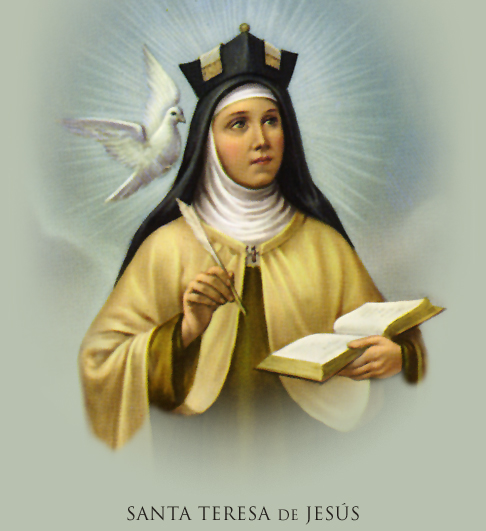
El Capullo de Santa Teresa de Jesus

Este domingo viajamos a dos ciudades que son famosas por sus relicarios de Santa Teresa de Ávila. Teresa de Avila (también conocida como Santa Teresa de Jesús) era una mujer muy sabia. Era un médico de la divinidad en un momento en que a las mujeres raras veces se les permitió participar en la vida intelectual de la sociedad. Ella era un judía conversa, mística, fundadora de la rama de las monjas carmelitas descalzos, y una escritora prolífica.

Ella nació en Ávila, 28 de marzo de 1515 y murió en Alba de Tormes el 4 de Octubre 1582 de cáncer de útero. Estos lugares son importantes porque esas dos ciudades han luchando durante quinientos años de la posesión de varios pedazos de su cuerpo muerto (relicarios).


Parece que a todo el mundo (literalmente) le gustaría tener un pedazo de Santa Teresa de Jesús. Ávila, su ciudad natal, ha pedido que su cuerpo sea devuelto, pero hasta ahora, han tenido que conformarse con un dedo. Su corazón y brazo están en exhibición en Alba de Tormes, y su cuerpo está enterrado ocho metros bajo el suelo de piedra de una iglesia que está bloqueado además de nueve cerraduras (las llaves están en exhibición en el museo). Su tumba se ha abierto varias veces para echar una mirada al cuerpo. La última vez que esto ocurrió fue 1914, y en ese momento (como en todas las visitas anteriores) su cuerpo parecía ser conservado milagrosamente (obviamente menos un brazo, un dedo, y un corazón).


Cuando estaba viva que se creía que ella tenía el don de proteger a quienes estaban en su presencia, y en la muerte, este poder parece haber permanecido inalterada. De hecho, ella fue llevada en 1582 a Alba de Tormes, a petición del duque de Tormes, que quería su presencia en la ciudad para proteger el nacimiento de su hijo. Bueno, después del nacimiento del niño, no fue capaz de viajar después, porque su cuerpo se estremecía con el cáncer, y ella murió allí lejos de Ávila.
Supongo que el pueblo de Alba de Tormes pensó que había tocado el premio gordo. Enterraron el cuerpo del santo en una iglesia, concediendo sólo un dedo a Ávila junto con el resto de la mano que había desaparecido misteriosamente (más sobre esto en un momento). Insistieron en que Santa Teresa había dicho que quería ser enterrada allí mismo, en Alba de Tormes, y allí se quedaba, supuestamente asegurando la prosperidad y la protección a la ciudad.


Alba de Tormes, a pesar de estar situado en una bella área de tierra al lado del río Tormes,no ha tenido mucho suerte.El hermoso palacio del duque fue arrasada en la guerra contra los franceses, y la hermosa catedral que había sido diseñado y planificado nunca fue capaz de recaudar los fondos para construir más allá de una concha de piedra rodeada de andamios. La ciudad nunca volvió a alcanzar la grandeza que había disfrutado en el siglo 16.

Y Ávila? La ciudad es hoy una bella ciudad amurallada, que atrae a miles de turistas cada año, con una economía floreciente.

Y ¿qué pasa con esa mano que faltaba? El general Franco, supuestamente había dormido con la mano en su cama todas las noches durante su increíblemente largo tiempo como dictador 1939-1975. Ahora la mano se ha vuelto, esperamos en condición "incorrupta".


Qué tiene la carne de Santa Teresa que lleva tanto poder? ¿La carne de nuestra ajena podría ayudar a nuestro propio progreso espiritual? Esto me parece poco probable.

Creo que el cuerpo es solo un estuche para el alma, es algo que dejamos atrás después de que ya no la necesita. La recolección de partes de los cuerpos de nuestros santos queridos no es más eficaz en nuestra evolución que una mariposa que intenta recoger los capullos rotos de sus compañeros.


Cada uno de nosotros debe asumir la responsabilidad de nuestro propio progreso y el desarrollo espiritual. Lo que tomamos de Teresa de Jesús o de cualquier otro gran maestro debe ser las lecciones que podemos aprender de su vida, obras, y escritura. De Santa Teresa se puede aprender la sencillez, la humildad, la devoción y el valor de la búsqueda eterna de algo más allá del material.
Santa Teresa ha sido inmortalizada por su trabajo. No necesitamos relicarios mágicas para probar su valor.

 
This past Sunday we traveled to two cities which are famous for being the home to the relics of Teresa de Ávila. Teresa de Avila (also known as Teresa of Jesus) was a very wise woman. She was a doctor of divinity at a time when women were seldom allowed to participate in the intellectual life of the society. She was a Jewish convert, mystic, founder of the Carmelite branch of barefoot nuns, and a prolific writer.


She was born in Ávila, March 28 de 1515 and died in Alba de Tormes on October 4, 1582 of Cancer of the Uterus. These locations are important because those two cities have been fighting for five hundred years over parts of her dead body (relics).

It seems like everybody (literally) would like to have a piece of Saint Teresa of Jesus. Though Ávila, her birthplace, has requested that her body be returned, they have, so far, had to be satisfied with one finger. Her heart and arm are on display in Alba de Tormes, and her body is buried eight meters under the stone floor of a church which is locked behind nine different locks (the keys are on display in the museum). Her grave has been opened from time to time over the years to have a look at the body. The last time this happened was 1914, and at that time (as with all the previous visits) her body appeared to be miraculously preserved (obviously minus one arm, one finger, and a heart).

When she was alive she was believed to have the power to protect those in her presence, and in death, this power seems to have remained undiminished. In fact, she was brought in 1582 to Alba de Tormes at the request of the Duke of Tormes, who wanted to have her present in his city to protect the birth of his child. Well, she protected that child’s birth, but was not able to travel on afterward, because her body was racked with cancer, and died there.

I suppose the people of Alba de Tormes thought that they had hit the jackpot. They buried the entire body of the Saint in a church, conceding only a finger to Avila along with the rest of the hand that had mysteriously disappeared (more about this later). They insisted that Saint Teresa had mentioned that she wanted to be buried right there in Alba de Tormes, and there she would stay, bringing prosperity and protection to the city.

Though Alba de Tormes is located in a lovely piece of land right next to the river Tormes, the duke’s beautiful palace was razed to the ground in the civil war, and the beautiful cathedral that had been designed and planned was never able to raise the funds to build it beyond a large stone shell surrounded by scaffolding. The city never again reached the greatness that it had enjoyed in the 16th century.

Avila? The city is today a beautiful walled city which attracts thousands of tourists every year, with a thriving economy.

And what about that missing hand? General Franco supposedly slept with the hand in his bed every night. Perhaps this explains his incredibly long position as dictator 1939-1975. It has now been returned, we hope in “uncorrupted” condition.

So what is it about the flesh of Santa Teresa that carries so much power? Does the material flesh of another help our own spiritual progress? This seems unlikely to me.

The way I see it, the body is a shell for the soul; it is something we leave behind after we no longer need it. Collecting the body parts of our beloved saints is no more effective in our evolution than a butterfly trying to collect the broken cocoons of its fellow butterflies.

Each of us must take responsibility for our own progress and spiritual development. What we take from Teresa de Jesus or any other great teacher should be the lessons that we can learn from her life, works, and writing. From Saint Teresa we can learn simplicity, humility, devotion, and the value of the timeless search for meaning beyond the material.

Santa Teresa has been immortalized by her work. We don’t need magical relics to prove her value or lasting worth.